Battle Stations, Battlescreens: Inside the Insane Home Tournament Setups Turning Living Rooms Into Arenas
There's a moment — and if you're a gamer, you know exactly the one — where you're mid-match, the lag spikes, your monitor flickers, and you lose a ranked game you absolutely should have won. You sit back, stare at your setup, and think: it's time.
That moment is happening in living rooms, spare bedrooms, and finished basements all across America. And the results? Spectacular, borderline unhinged, and somehow completely justified.
Welcome to the home tournament setup arms race — where casual players are dropping serious doubloons to build competitive rigs that rival what you'd find at a pro esports facility. The line between "guy who games on weekends" and "person with a dedicated tournament command center" has never been blurrier, and honestly? We're here for every ridiculous, glorious pixel of it.
The Numbers Don't Lie (But They Do Make Your Wallet Cry)
Let's talk money, because this is where things get genuinely wild. According to industry analysts, the US gaming peripherals market is projected to sail past $6 billion by 2026. Mechanical keyboards, 240Hz monitors, ultrawide curved displays, custom desk mounts, soundproofing panels — the shopping carts of America's competitive-casual gamers are overflowing.
Marcus T., a 29-year-old project manager from Columbus, Ohio, recently totaled up what he's spent on his setup over the past two years. The number: just north of $4,800.
"I told myself it was an investment," he says, laughing. "Like, I'd spend this on a vacation. Except the vacation is every night in my office."
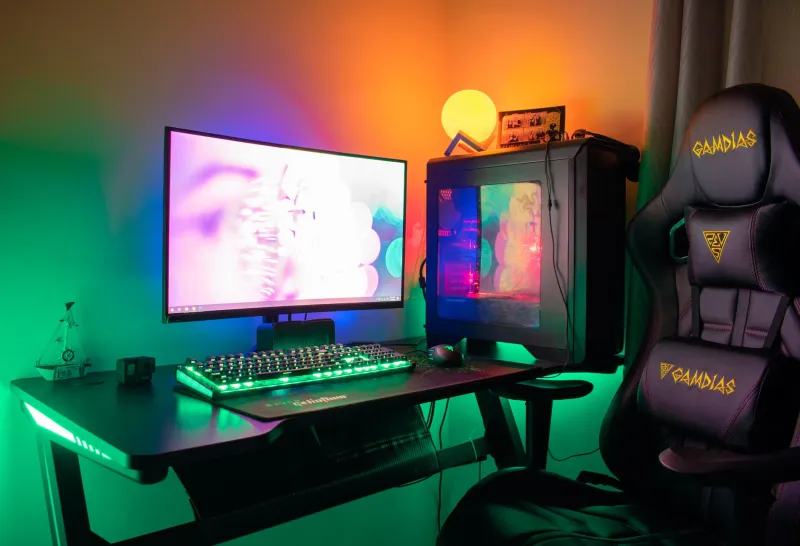
His setup includes a 27-inch 1440p 165Hz monitor flanked by two secondary screens, a standing desk with programmable height presets, a high-end mechanical keyboard with custom keycaps, and — his personal pride — an LED lighting strip system synced to in-game events so his room literally pulses red when he takes damage.
Is he a professional esports player? No. Does he compete in online tournaments through platforms like Battlefy or Checkmate Gaming? Absolutely, every other weekend.
The Psychology of the Battle Station
So why are people spending this kind of money? Psychologists who study gaming behavior point to a few overlapping forces at work.
First, there's what researchers call "environmental priming" — the idea that your physical surroundings shape your mental state. When you sit down at a setup that looks professional, your brain starts treating the session more seriously. You focus harder. You warm up properly. You stop alt-tabbing to check Twitter every four minutes.
"The setup becomes a ritual," explains one behavioral researcher who studies competitive gaming habits. "It signals to your brain: this is performance time. It's not that different from an athlete putting on their uniform."
Second, and perhaps more entertainingly, there's pure, unapologetic peacocking. Gaming setups have become a social currency on platforms like Reddit's r/battlestations, TikTok, and YouTube, where setup tour videos routinely pull millions of views. When Chicago-based streamer and weekend tournament grinder Dani R. posted a time-lapse of her new desk build — custom pegboard, cable management that looked like modern art, and a monitor arm setup she described as "the Eiffel Tower of peripheral mounting" — it racked up 200,000 views overnight.
"People want to see the craft," she says. "It's like showing off your boat, honestly. Everyone's got one, but yours has the good cup holders."
What the Manufacturers Know That You Don't
Here's the part of the story where we follow the money upstream, because the gaming hardware industry has read this cultural moment like a treasure map and is sprinting toward the X.
Brands like Secretlab, Herman Miller (yes, that Herman Miller — the office chair people), Elgato, Corsair, and LG have all made aggressive pivots toward the "serious home gamer" demographic in recent years. Herman Miller's collaboration with Logitech G produced a $1,495 gaming chair that sold out almost immediately. Elgato built an entire product ecosystem — lights, stream decks, microphone arms — specifically engineered for the home content-creator-slash-competitor.
The marketing language is telling. Phrases like "compete from anywhere," "pro-grade performance," and "your home, your arena" are everywhere. These companies aren't selling you equipment — they're selling you an identity. The Admiral of Your Own Living Room. The Captain OK of your apartment's spare bedroom.
And it's working, because the alternative — showing up to an online tournament with a budget setup while your opponent is running a rig that looks like NASA's mission control — feels like bringing a rowboat to a naval battle.
The Real Competitive Edge (It's Not What You Think)
Here's where Captain OK has to drop some honest truth alongside the hype: does all this gear actually make you better?
Kinda. But also, kinda not.
A 240Hz monitor genuinely does reduce input lag in ways that matter at high levels of play. A mechanical keyboard with a lighter actuation force can improve reaction times marginally. Good audio equipment — headsets that let you hear footsteps clearly — provides a real tactical advantage in shooters.
But a $300 keyboard won't fix your positioning in Valorant. A $1,200 monitor won't teach you build mechanics in Fortnite. The gear is a ceiling raiser, not a floor lifter.
Jared K., a semi-competitive Street Fighter 6 player from Austin, learned this the expensive way. "I spent $700 on a fight stick, a new monitor, the works. Then I went online and got absolutely cooked by some dude playing on his laptop." He pauses. "That guy had better fundamentals. I had better vibes."
The veterans of the home tournament scene will tell you the same thing: upgrade your setup incrementally, prioritize the pieces that address your actual weak points, and never — never — let gear shopping become a substitute for practice.
Building Your Own Command Deck (Without Sinking Your Finances)
If the arms race has you inspired but not yet ready to remortgage your apartment, here's the Captain OK guide to leveling up smart:
Start with your monitor. A 144Hz display at 1080p is the single biggest performance upgrade most casual-competitive players can make, and quality options exist in the $200–$300 range.
Your chair matters more than your desk. You're sitting in it for hours. A good ergonomic chair prevents fatigue and keeps you sharp late in a tournament bracket.
Cable management is free confidence. A tidy setup genuinely changes how you feel at the helm. Velcro cable ties cost $8 and deliver a disproportionate amount of satisfaction.
RGB is optional, but deeply fun. Look, the lights don't make you better. But they make the whole experience feel more alive, and fun is kind of the whole point here, right? Set Sail for Fun, Games & Good Times — that's not just a slogan.
The Armada Is Growing
What's most fascinating about the home tournament setup boom isn't the gear — it's what it represents. A generation of gamers who grew up watching esports pros compete in front of screaming arenas have decided they don't need an arena. They've built their own. One desk, one monitor, one RGB strip at a time.
The living room has become the colosseum. The spare bedroom is the stadium. And somewhere in Columbus, Ohio, a project manager's office is currently pulsing red because he just took a rocket to the face in a Saturday night online tournament — and he wouldn't trade it for anything.
All hands on deck. The home competitive era has officially set sail.